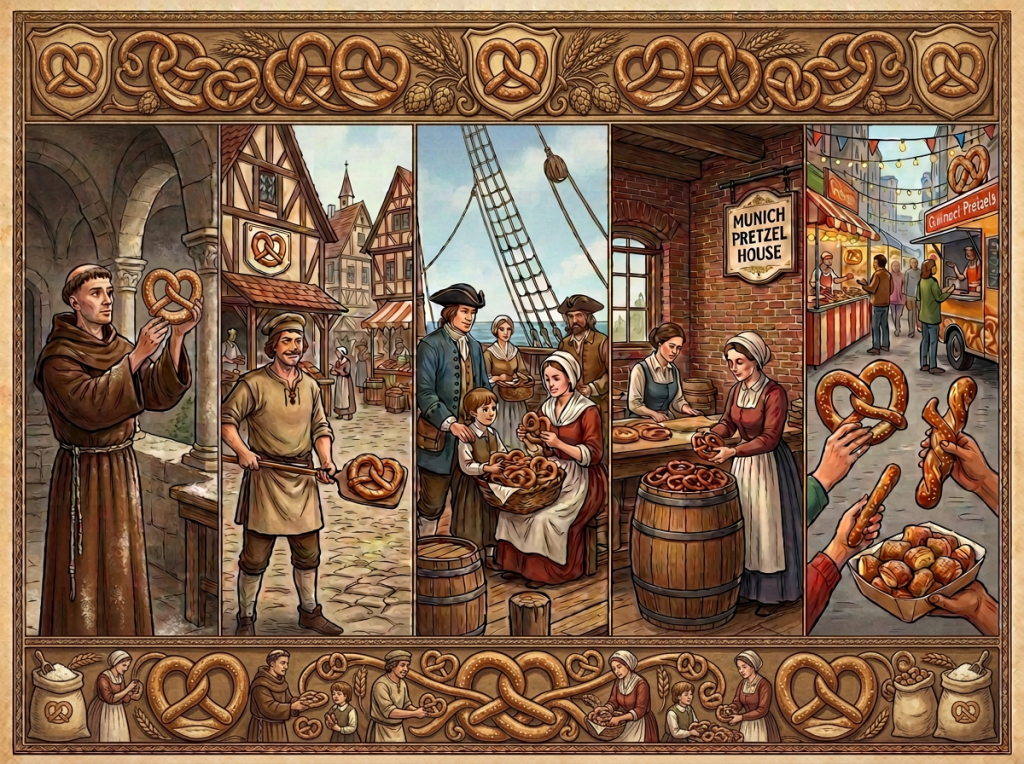
The pretzel’s history reflects a blend of religious symbolism, culinary innovation, and cultural adaptation. From its monastic origins as a Lenten treat to its role in guilds, legends, and modern snack culture, the pretzel has maintained its iconic twisted shape that has endured popularity across centuries.
Timeline and Evolution
The pretzel is believed to have been invented around 610 AD by a monk in Italy, who shaped strips of dough into the form of folded arms in prayer to reward children for learning their prayers during Lent. These early pretzels were called “pretiola” (little rewards) or “bracellae” (little arms), and were made from a simple mixture of flour, water, and salt, suitable for consumption during fasting periods when eggs, dairy, and meat were prohibited.
In medieval Europe, pretzels were closely associated with Christian traditions. Their distinctive knot shape was interpreted as a symbol of the Holy Trinity, with the three holes representing the Father, Son, and Holy Spirit. Pretzels were commonly eaten during Lent and Easter, and they were sometimes distributed to the poor as a form of both spiritual and physical sustenance.
By the 12th century, pretzels appeared in manuscripts and were used as emblems by German bakers’ guilds, highlighting their cultural and professional significance.
During the Middle Ages, pretzels became a symbol of good luck, prosperity, and spiritual fulfillment. Legends recount that in 1510, Austrian monks used pretzels to alert the city of Vienna to an Ottoman attack, earning bakers a coat of arms as a reward.
By the 17th century, pretzels were incorporated into wedding ceremonies in Switzerland, symbolizing undying love and possibly inspiring the phrase “tying the knot”.
Additional Meaning
The pretzel has been considered by various cultures to symbolize life. Looking at its basic construction, it begins thinly, intertwines, gets thicker and flares out into a circle, coming back to a thin end. The spelling with a “P” is English. In Germany, it is spelled with a “B”, so it starts softly, becomes strong with the “z” in the middle and rolls out into the “l”.
A Time-Tested Tradition
The pretzel has evolved into soft and hard varieties, with the traditional soft pretzel remaining popular in Germany and across the world. The characteristic deep-brown crust is achieved by dipping the dough in boiling lye or washing soda before baking, producing a unique flavor and texture.
Today, pretzels are enjoyed globally as a snack, often salted, glazed, or topped with mustard, cheese, or sweet coatings. They are always a fan favorite at our Oktoberfest, Maifest and other celebrations!


